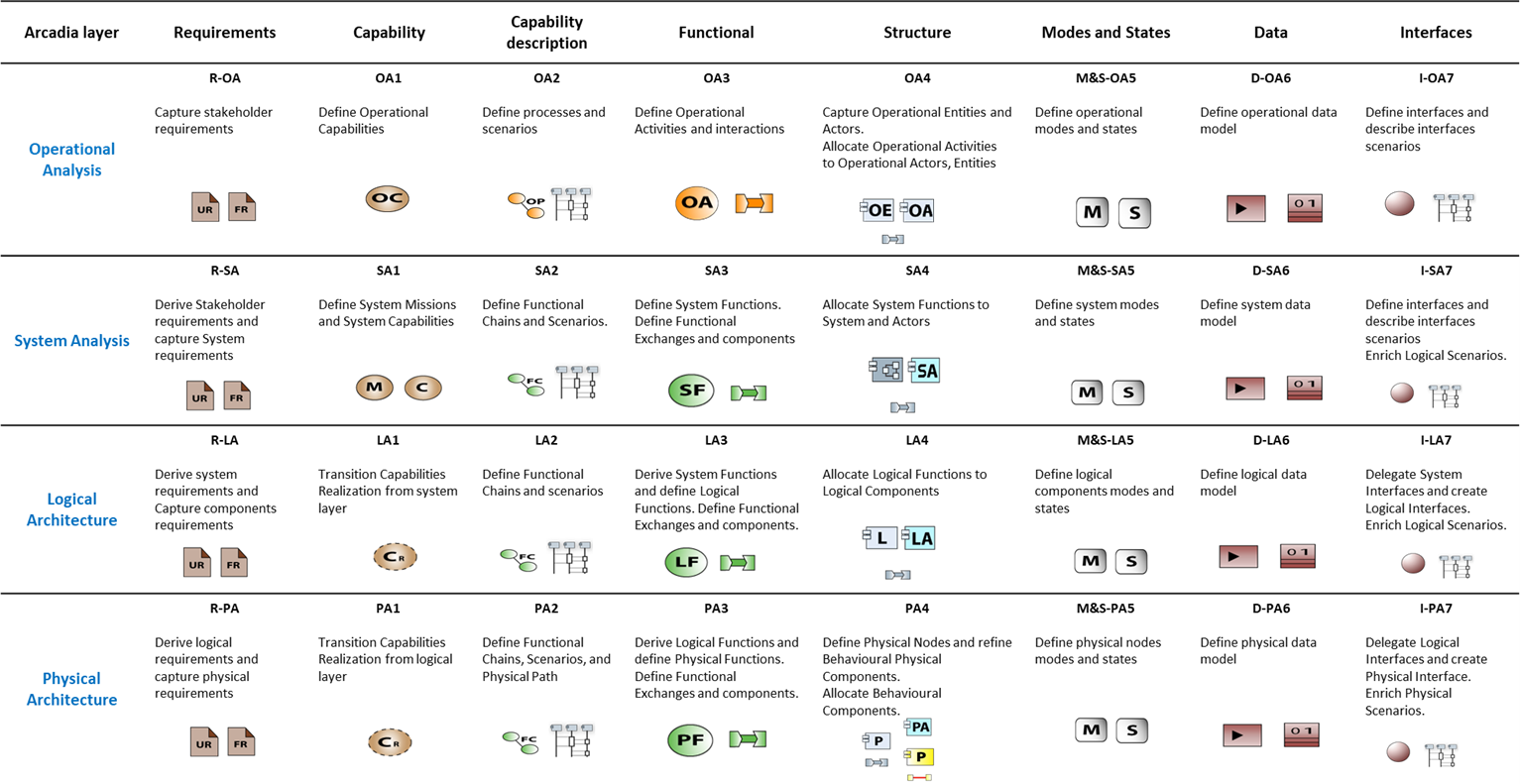
Arcadia is a tooled method devoted to systems & architecture engineering, supported by Capella modelling tool.
It describes the detailed reasoning to
It can be applied to complex systems, equipment, software or hardware architecture definition, especially those dealing with strong constraints to be reconciled (cost, performance, safety, security, reuse, consumption, weight…).
It is intended to be used by most stakeholders in system/product/software or hardware definition and IVVQ as their common engineering reference and collaboration support.
Arcadia stands for ARChitecture Analysis and Design Integrated Approach.
A series of online documents to dive into the principles and concepts of Arcadia:
Arcadia is a system engineering method based on the use of models, with a focus on the collaborative definition, evaluation and exploitation of its architecture.
This book describes the fundamentals of the method and its contribution to engineering issues such as requirements management, product line, system supervision, and integration, verification and validation (IVV). It provides a reference for the modeling language defined by Arcadia.
Jean-Luc Voirin, leader of the creation of the Arcadia method, along with some of the leaders on developing and deploying MBSE Arcadia & Capella practices in Thales. From right to left: Pierre Nowodzienski, Jean-Luc Voirin, Juan Navas, Stephane Bonnet, Frederic Maraux, Gerald Garcia, Philippe Fournies, Eric Lepicier.
Architecture as prime engineering driver
Arcadia, a model-based engineering method
Noticeable features of Arcadia
Definition of the Problem - Customer Operational Need Analysis
Formalization of system requirements - System Need Analysis
Development of System Architectural Design - Logical Architecture (Notional Solution)
Development of System Architecture - Physical Architecture
Formalize Components Requirements - Contracts for Development and IVVQ
Co-Engineering, Sub-Contracting and Multi-Level Engineering
Adaptation of Arcadia to Dedicated Domains, Contexts, Etc.
Equivalences and Differences between SysML and Arcadia/Capella
To keep the show contemporary (2010s), the production used clean sans-serifs for technology.
The Vampire Diaries' fonts have left a lasting impact on the world of television branding and typography. The show's distinctive title font, in particular, has inspired numerous fan-made recreations and adaptations. The use of elegant, refined fonts in TV show branding has also become a trend, with many series opting for similar typography to convey a sense of sophistication and drama. vampire diaries fonts
A huge part of TVD’s storytelling comes from diaries, letters, and old journal entries. To keep the show contemporary (2010s), the production
Beyond the specific logo, the show’s overall marketing and fan art often rely on a "dark academic" or Gothic design style. Vampire Diaries handwriting style examples needed The use of elegant, refined fonts in TV
Identifying a single font for the books is more difficult because the lettering is widely believed to be hand-drawn rather than a standard typeface.
The primary logo for the TV show (2009–2017) uses a customized sans-serif typeface
Once you have secured your Vampire Diaries-inspired fonts, the possibilities for creative projects are endless. Here are a few ways fans and designers bring Mystic Falls to life: